Growing via frequency – a realistic pathway?
Possible, but not easy: purchase frequencies are stable
Highest “stability” among non-buyers
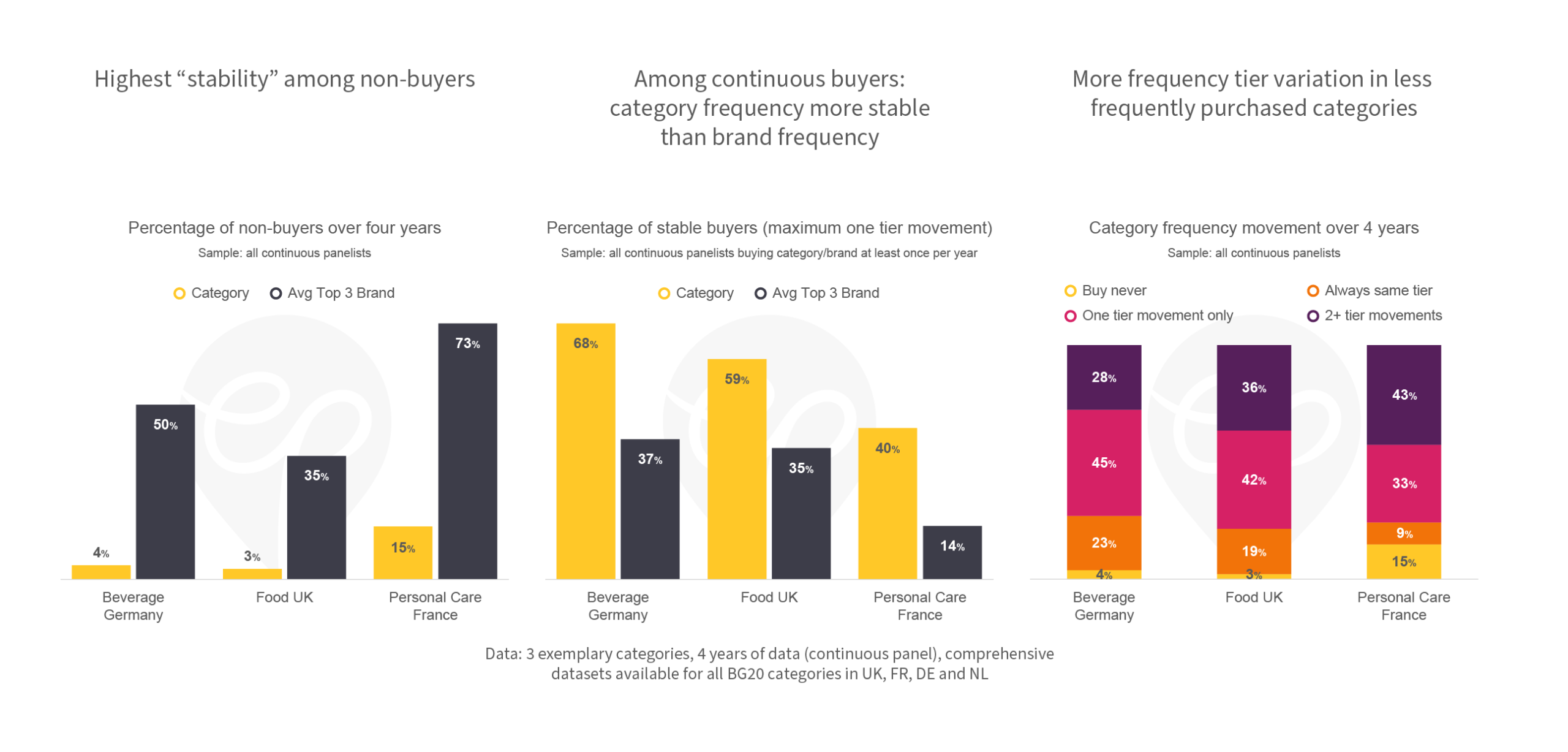
We looked at how often households bought from a category and from individual brands over four years. In each year, we placed households into one of five groups: non-buyers, light, medium, heavy, or super-heavy buyers, based on how often they purchased (e.g. medium buyers: between 25% and 50% of the category frequency). At brand level, the largest and most stable group over time is non-buyers – these are all households that never buy a given brand across the four years. Its large size is expected for smaller brands, but it is also true for the average Top 3 brand, particularly in categories that are bought less often.
Among continuous buyers: category frequency more stable than brand frequency
When we look only at households that bought a category or a specific brand at least once every year, category buying frequency is more stable than brand buying frequency. Overall, around half of all category buyers move by no more than one tier, for example from medium to heavy or from medium to light. For brands, the equivalent figure is much lower – if a brand is established in a household’s repertoire, its frequency over time varies more than overall category frequency. This suggests that creating more buying occasions for a category is possible, but difficult, because category purchase frequency tends to remain rather stable.
More frequency tier variation in less frequently purchased categories
Across all households, big shifts between buying frequency tiers are rare, but more common in low frequency categories. Some of that movement is by households shifting from the non-buyer to the medium tier (or back) – likely triggered by promotional activities. Unfortunately, such frequency hikes may not be sustainable and only signal purchase acceleration or stockpiling. To initiate sustainable changes in category frequency, brands need to propose new usage occasions, stimulate habit formation or innovate around additional need states. The other avenue for growth is the more traditional one: steal occasions from your competition.