Making sense of Private Label Success – Part 1
Its relationship with category characteristics is not always as expected
Higher category brand price premia not linked to Private Label success
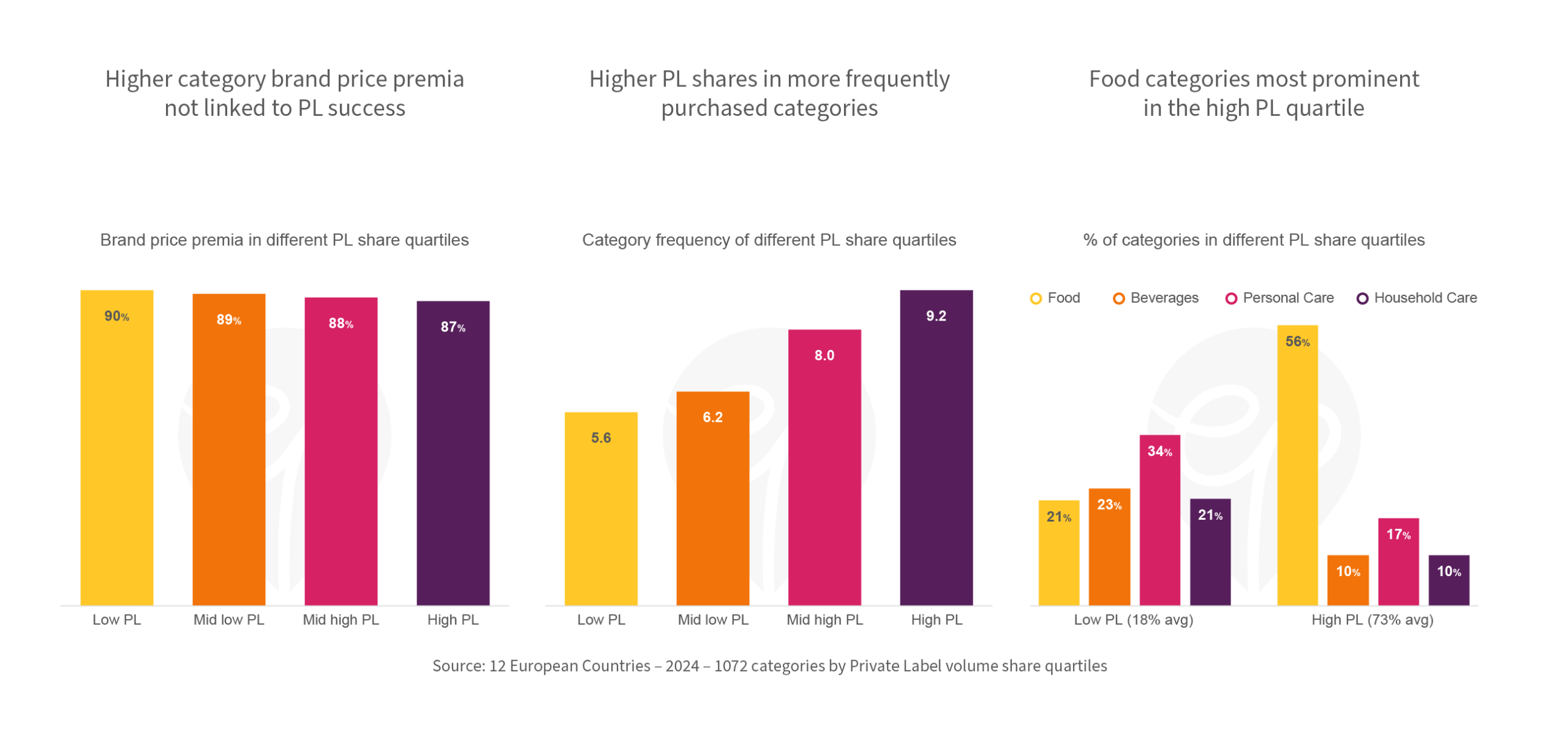
We ranked 1072 categories by their volume Private Label shares and grouped them into four quartiles. Do categories in these quartiles differ with respect to the price premium brands command versus Private Labels? While one might expect that Private Label does better where brands are more (that is, too) expensive, the average price premium is almost identical across the quartiles. On average, brand buyers are willing to pay about 90% more – but their number and intensity differs. How does your category (and your brand) stack up?
Higher Private Label shares in more frequently purchased categories
Private Label shares are lower on average in less frequently bought categories. This could result from both supply- and demand-side factors: retailers may have more incentive to push their Private Labels in more frequently purchased categories – and consumers may be less concerned about prices (and more about quality?) where decisions are less frequent and longer-lasting.
Food categories most prominent in the high Private Label quartile
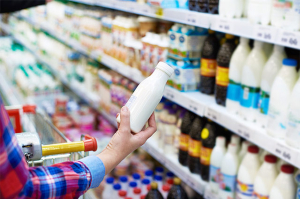
The category make-up of the four quartiles differs quite a lot: Private Label shares are much less likely to be low in Food categories which account for almost six out of ten categories in the high Private Label quartile. Personal Care categories represent 34% of the low Private Label quartile, but only 17% of the high Private Label quartile. This difference aligns with the buying frequencies of these two category types.